


Theme 1. Advanced Layered Cathode Materials
Designing high-performance cathodes from crystal structure to particle architecture
Layered oxides remain the foundation of high-energy lithium-ion batteries, yet their performance is limited by structural instability, interfacial degradation, and uneven reactions during cycling. We develop advanced layered cathodes through the integrated control of composition, crystal structure, primary-grain orientation, particle morphology, and surface chemistry.
Our goal is to achieve cathode materials that combine high energy density with fast lithium transport, robust structural reversibility, long cycle life, and reduced dependence on scarce elements. Rather than optimizing composition alone, we design the entire material—from atomic arrangement to secondary-particle architecture.
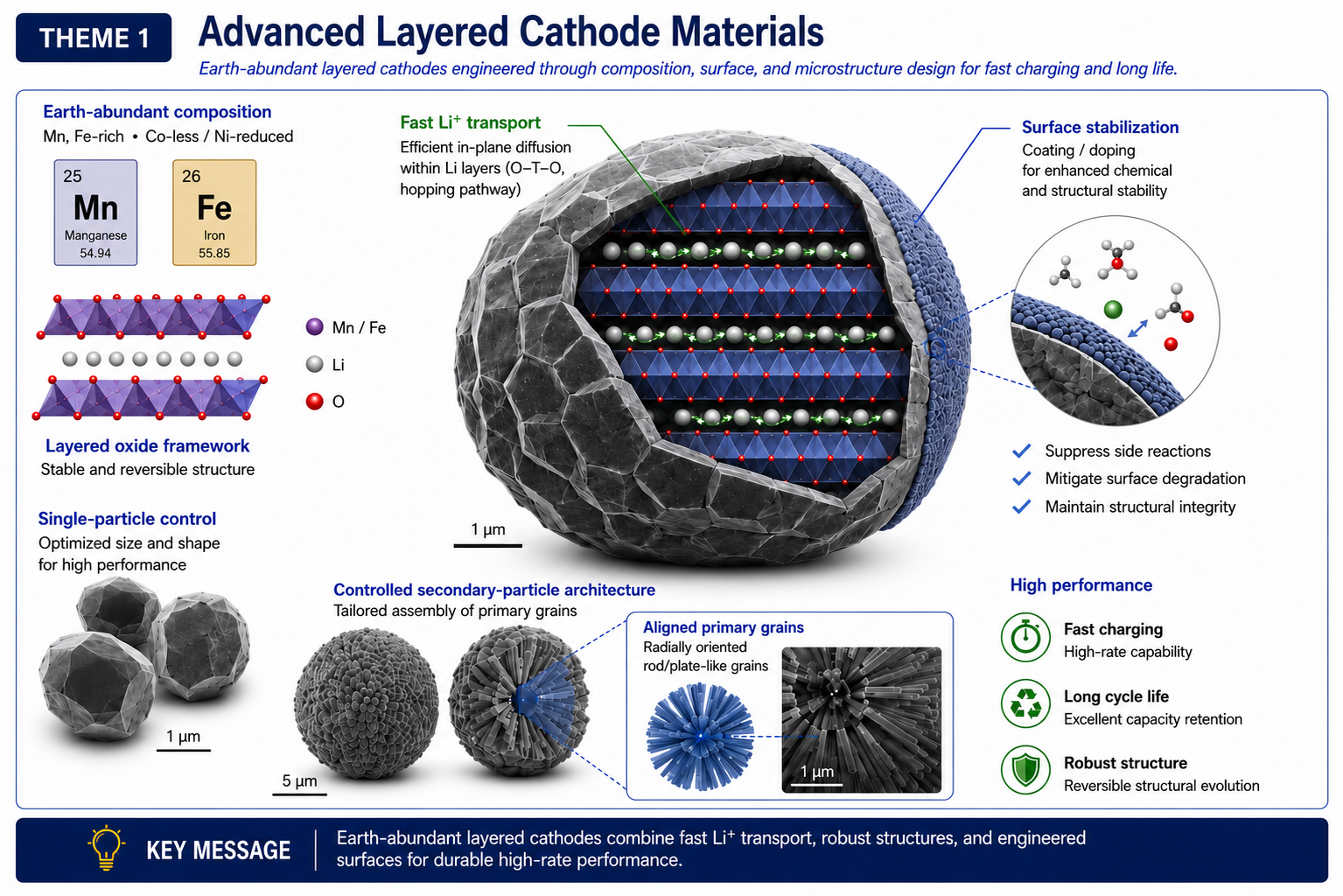
Keywords: layered oxides · Mn-rich cathodes · Co-lean chemistry · single-crystal particles · particle engineering · surface stabilization
Theme 2. Disorder-Enabled and Emerging Cathode Chemistry
Expanding the cathode design space beyond conventional ordered structures
Conventional layered cathodes rely on highly ordered crystal frameworks and a limited set of transition-metal redox reactions. We explore disordered and emerging cathode chemistries in which diverse local atomic environments, three-dimensional lithium pathways, and oxygen-redox-active motifs open new possibilities for energy storage.
By understanding how local coordination, cation disorder, and Li–O–Li configurations regulate electrochemical reactions, we aim to establish new design principles for high-capacity materials beyond conventional compositional and structural limits. Disorder is not treated simply as a defect, but as a controllable degree of freedom for materials design.
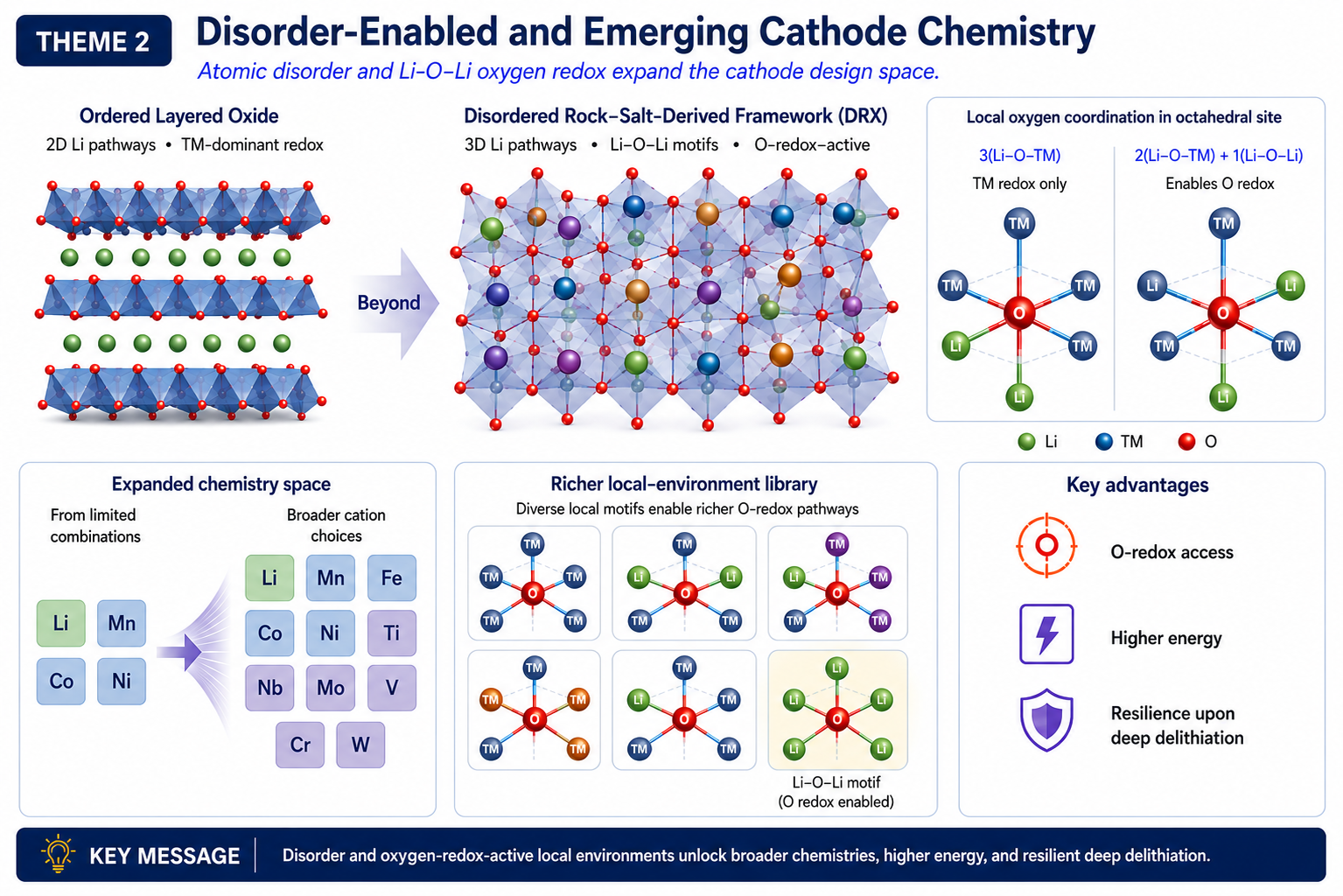
Keywords: disordered rock-salt cathodes · oxygen redox · local coordination · cation disorder · Li-rich materials · emerging cathode chemistry
Theme 3. Electrochemical Interfaces and Interphases
Understanding the dynamic boundary between active materials and electrolytes
The performance and lifetime of a battery are often governed by reactions occurring within only a few nanometers of the electrode surface. These interfacial regions continuously evolve through electrolyte decomposition, oxygen loss, transition-metal migration, surface reconstruction, and the formation of complex cathode–electrolyte interphases.
We investigate how the surface state of an active material interacts with electrolyte composition and how these reactions influence charge transfer, structural stability, and long-term degradation. Our objective is to move beyond separate descriptions of the cathode and electrolyte and understand their interface as a dynamic, coupled chemical system.
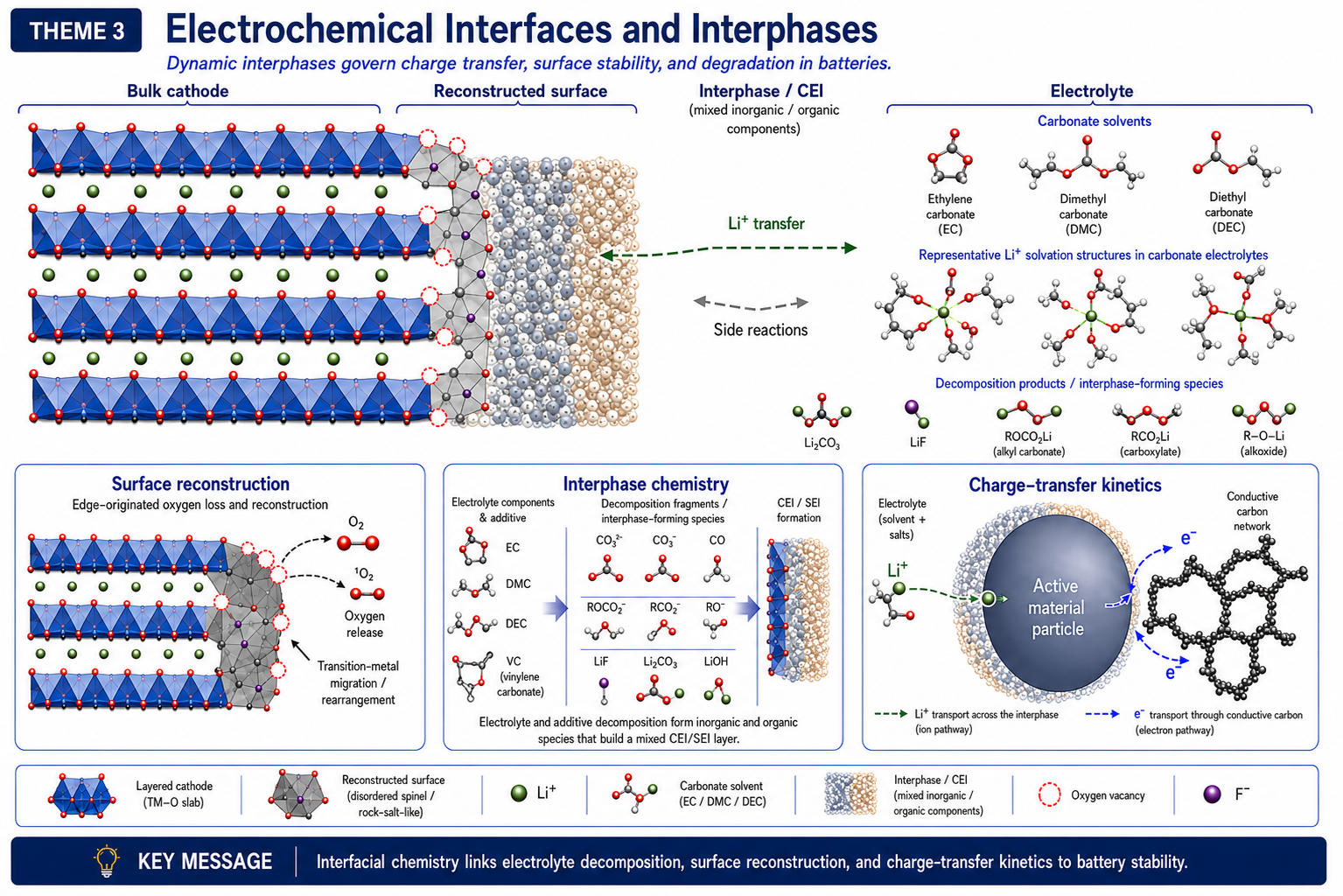
Keywords: cathode–electrolyte interface · CEI · electrolyte decomposition · surface reconstruction · oxygen loss · charge-transfer kinetics
Theme 4. Multiscale Reaction Dynamics
Revealing how real battery materials react across particles, space, and time
Battery electrodes do not behave as uniform materials. Individual particles may react at different rates, follow different phase-transformation pathways, and experience distinct local electrochemical environments—even within the same electrode.
We study reaction heterogeneity from the interior of a single particle to ensembles containing thousands of interacting particles. By resolving how reaction states develop, communicate, and relax during operation, we uncover collective behaviors that are hidden in conventional averaged measurements. This perspective allows us to connect microscopic reaction dynamics with macroscopic battery performance and degradation.
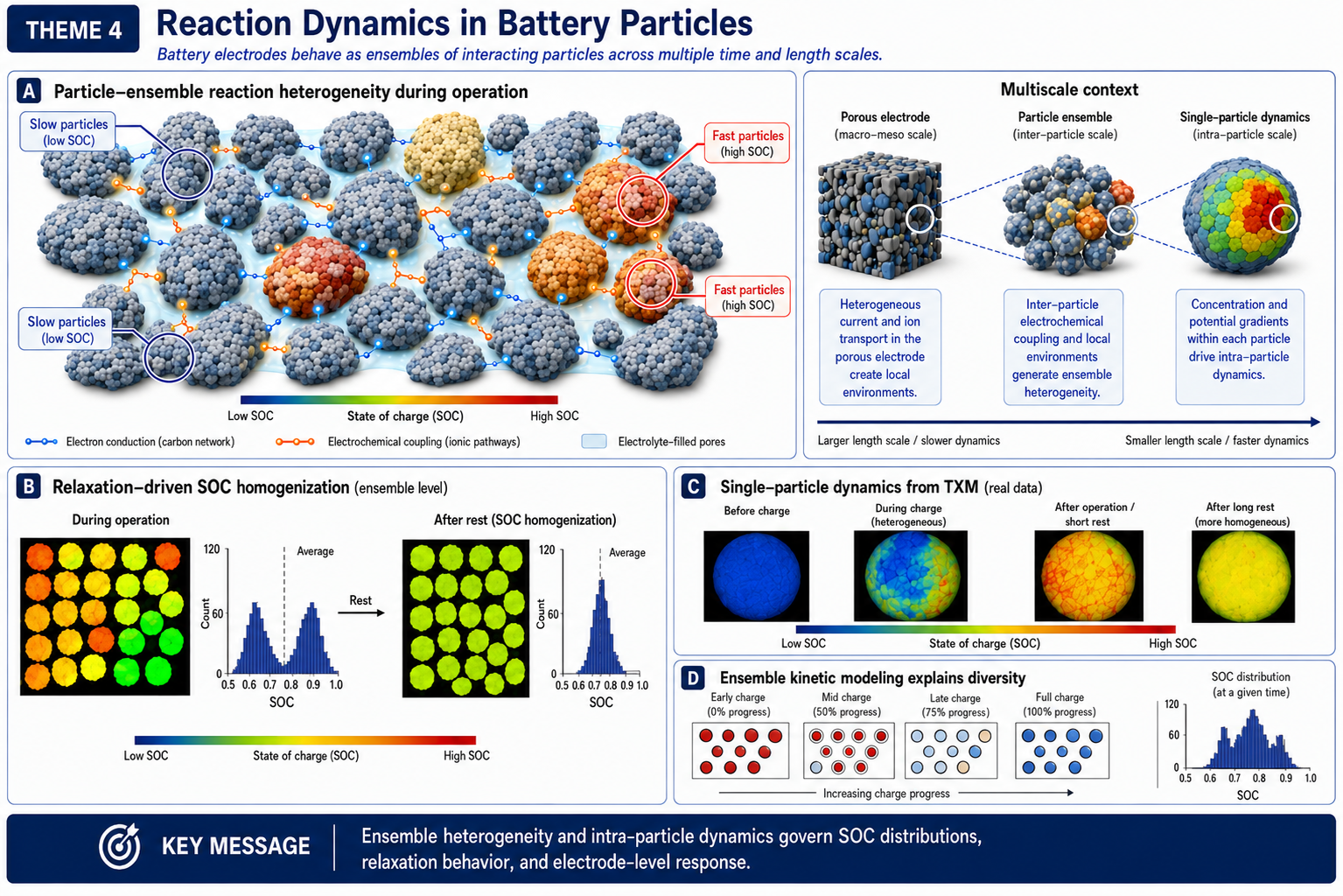
Keywords: reaction heterogeneity · particle ensembles · state-of-charge distribution · non-equilibrium dynamics · relaxation · single-particle behavior
Theme 5. Dynamics-Informed Electrode Design
Translating reaction mechanisms into better electrode architectures
Understanding reaction dynamics is not the end of our research—it is the basis for design. Practical electrodes contain active particles with different sizes, compositions, diffusion properties, interfacial kinetics, and electronic connectivity. When these kinetic factors are poorly matched, localized overreaction and underutilization accelerate performance loss.
We use mechanistic insight and simulation to coordinate lithium diffusion, interfacial charge transfer, ionic transport, and electronic wiring within composite electrodes. Our aim is to design kinetically matched particle ensembles that share reactions more uniformly, enabling fast charging, improved material utilization, and longer cycle life.
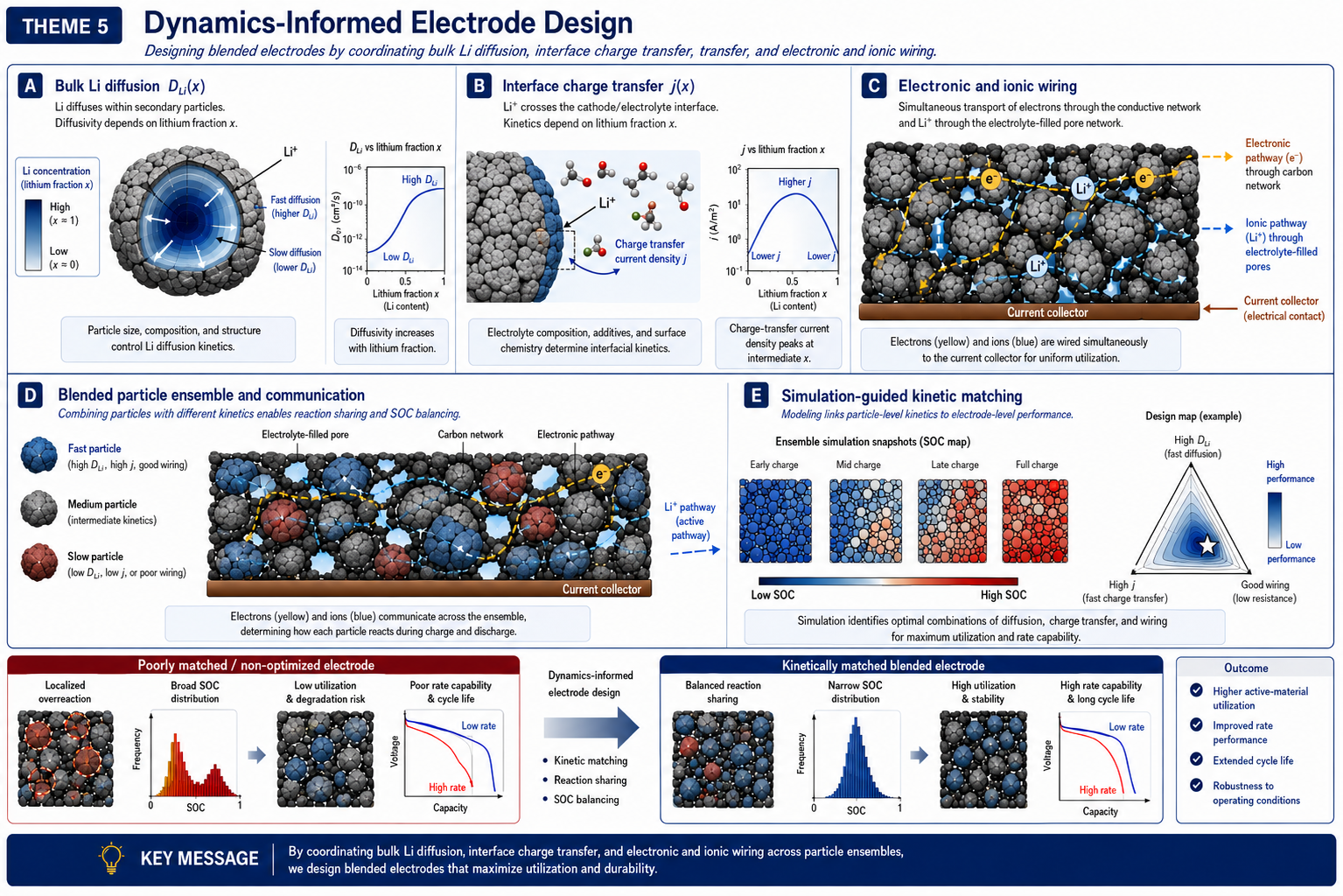
Keywords: electrode architecture · kinetic matching · particle blending · fast charging · electronic wiring · reaction sharing
Theme 6. Synchrotron-Enabled Multiscale Characterization
Observing battery reactions that conventional measurements cannot reveal
Many critical battery processes occur deep inside materials, evolve rapidly during operation, or differ strongly from particle to particle. To observe these hidden processes, we employ advanced synchrotron X-ray spectroscopy, diffraction, microscopy, and correlative imaging techniques.
These approaches allow us to connect electronic structure and oxygen redox at the atomic scale with interfacial chemistry, phase evolution, particle dynamics, and electrode-scale reaction heterogeneity. By combining operando measurements with complementary laboratory analysis and modeling, we reconstruct how batteries evolve across multiple length and time scales.
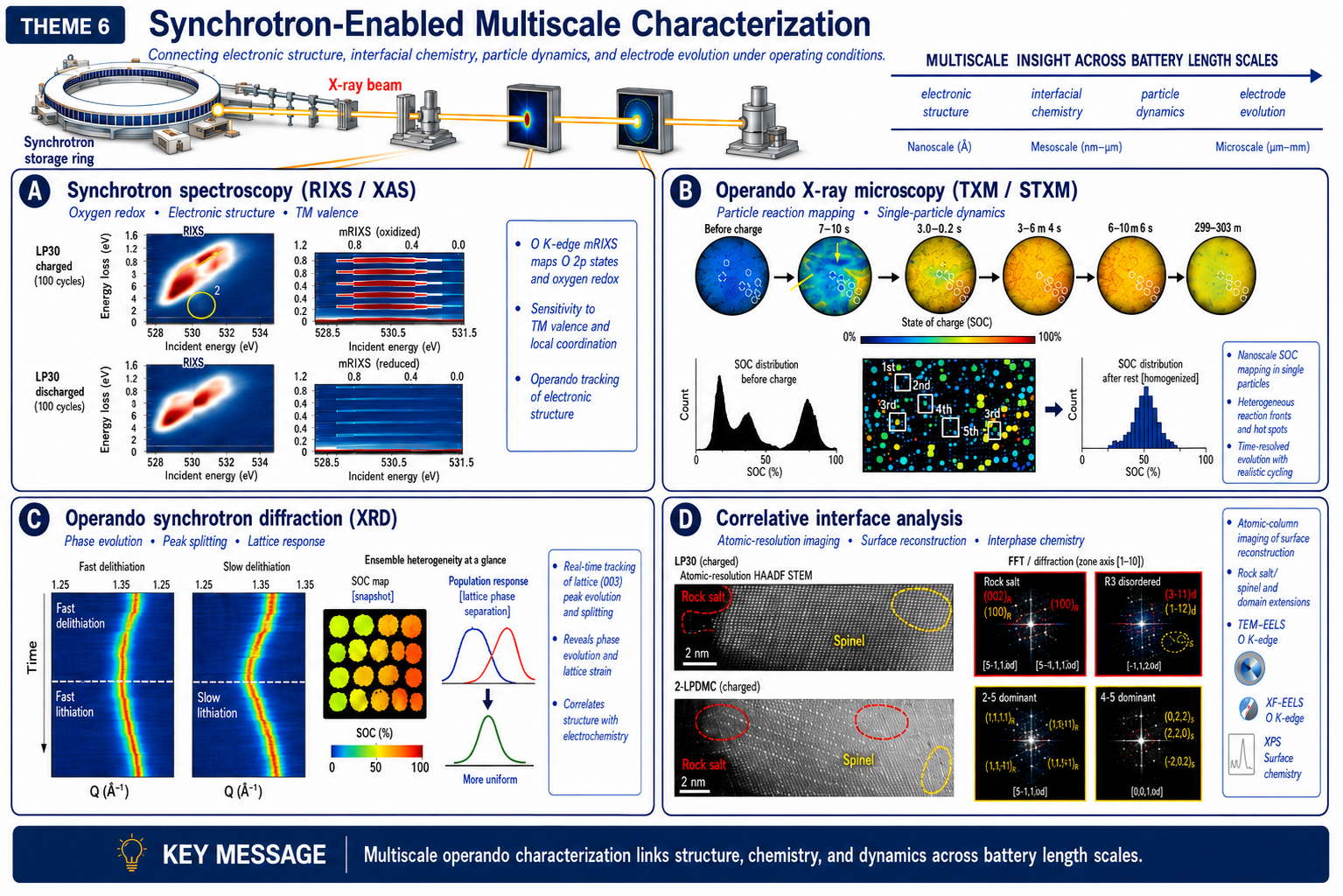
Keywords: operando characterization · synchrotron X-rays · RIXS/XAS · XRD/PDF · TXM/STXM · correlative analysis